Tuckpointing Versus Rebuilding: Which Your Chimney Needs
Most masonry chimneys need attention long before they need replacing. When mortar joints have eroded, cracked or fallen out but the bricks or stones are still sound and the chimney is plumb, repointing, often called tuckpointing, is the right repair. We rake or grind out the failed mortar to a consistent depth, pack new mortar in layers, and tool the joints to match the original profile.
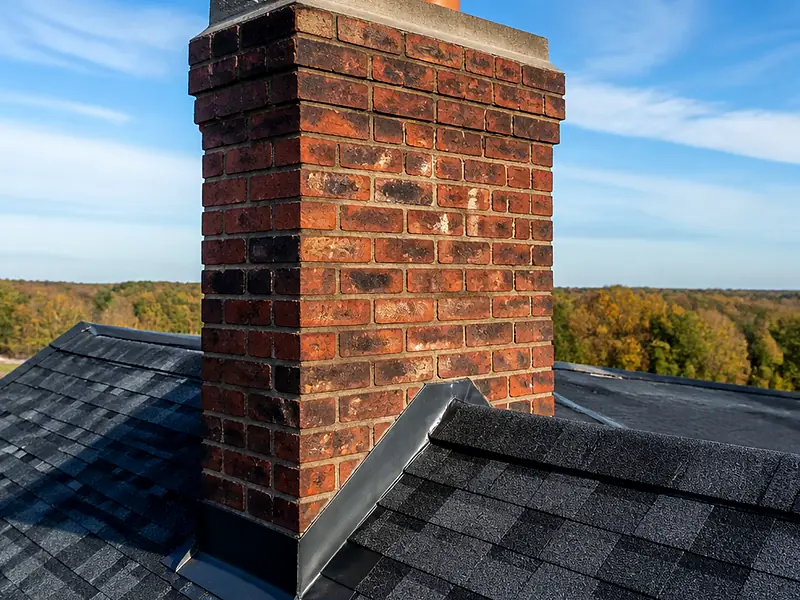
Chimney rebuilding comes into play when the damage goes past the joints: bricks that are spalled or loose throughout, a stack that is leaning or has shifted, or upper courses knocked loose by a falling limb. On Bernardsville's hilltop and wooded properties, the section above the roofline, exposed to every storm and every freeze, is where rebuilding is most often needed. We rebuild only as far down as the damage goes, which often means the top few feet rather than the whole stack. An inspection tells you which case you are in.
Mortar That Matches Historic Somerset Hills Masonry
Mortar selection is where many chimney repairs go wrong. Older homes in Bernardsville, including the Tudor Revival and Colonial Revival houses of the Olcott Avenue Historic District and the country houses of the Gilded Age Mountain Colony, were generally laid in softer, lime-rich mortar. Repointing that masonry with modern high-strength cement mortar creates joints harder than the brick around them. As the chimney moves with heat and frost, the brick cracks and spalls instead of the joint.
The National Park Service's guidance on repointing historic masonry sets out the principle we follow: new mortar should match the old in color, texture and tooling, and it should be softer and more vapor-permeable than the masonry units. We examine the existing mortar, choose a mix that meets those goals, and test the color on a small area before repointing the whole chimney. The result is a repair that looks right and lets the masonry last.
Stone Chimneys and Oversized Stacks
Stone is a signature of the Somerset Hills. Bernardsville's own railroad station, built in 1902 and listed on the National Register of Historic Places, is a stone building, and many estate houses on the mountain carry massive stone chimneys. Stone chimneys need a mason who can read how the original builder laid them: the size and bedding of each stone, the width and profile of the joints, and how water sheds off the face. Loose stones are removed, cleaned and reset in their original positions wherever possible, and replacements are chosen to match color and weathering.
Oversized brick stacks carrying several flues bring their own challenges. They are heavy, often tall, and rise from steep roofs, so we plan access, staging and roof protection carefully. Work on these chimneys is also the time to address the crown, flashing and caps, avoiding a second round of roof access later. Our chimney cap and crown and chimney leak repair services are often folded into the same project.
Partial and Full Chimney Rebuilds
A partial rebuild takes the chimney down to sound masonry, usually at or just below the roofline, and relays it with matching brick or stone, a new crown and new flashing. It is the most common kind of rebuild after storm damage or decades of water getting in at the top of the stack. A full rebuild, down to the firebox or foundation, is reserved for chimneys that are structurally unsound throughout, pulling away from the house, or sitting on a failing footing.
Either way, 1stCall Emergency Chimney documents the existing chimney with photos and measurements first, so the rebuilt section keeps its original height, shape and details, from corbeling to decorative banding, whether it is a stone stack on Bernardsville Mountain or a brick chimney near Olcott Square. Rebuilding is also the right moment to reline the flue, and our chimney liner team can install a new liner while the chimney is open.
Planning Masonry Work Around New Jersey Weather
Mortar and concrete need time and moderate temperatures to cure. In Bernardsville, where the higher elevations see more snow and colder nights than lower ground nearby, the best window for major masonry work usually runs from spring through late fall. That is also the season to catch problems before another winter of freeze-thaw cycles makes them worse. If you notice crumbling joints, fallen mortar or white efflorescence on the brick this fall, a repair before the first hard freeze prevents further damage.
When work cannot wait, such as a chimney damaged in a storm, we stabilize it right away and use cold-weather methods, including enclosures and heat, to complete essential repairs safely. Our masons also work in Far Hills, Warren and Bridgewater.