Finding Where a Chimney Leak Really Starts
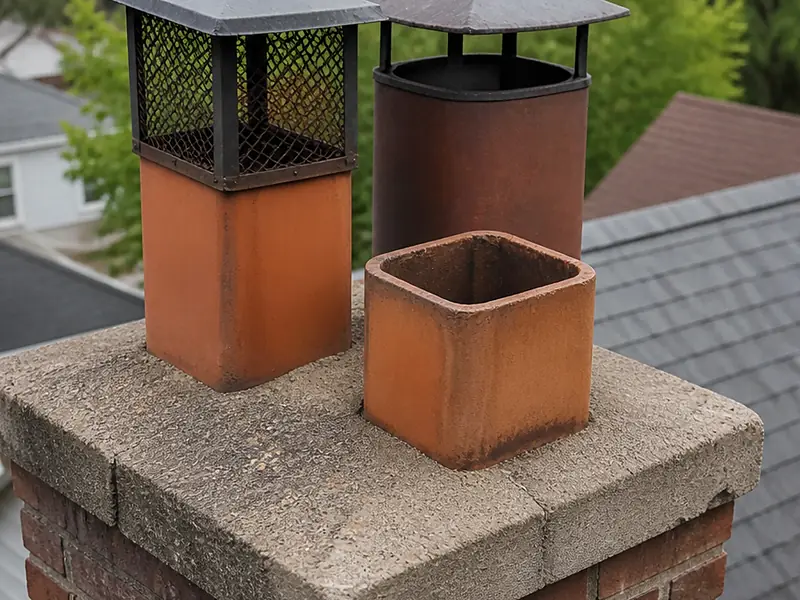
Water that shows up beside a fireplace or on a ceiling near the chimney has often traveled a long way before it appears. Effective chimney leak repair starts with diagnosis, not caulk. We look at five likely entry points: the flashing where roof meets chimney, the crown at the top, the masonry itself, an uncapped flue letting rain fall straight down, and condensation inside a flue that is poorly matched to its appliance. In the older homes around Olcott Square and on Bernardsville Mountain, it is not unusual to find more than one of these at work at the same time.
We inspect each one, check the attic and the chimney breast for staining patterns, and when needed run a controlled water test on one area at a time. Knowing exactly where water enters keeps you from paying for flashing when the real problem is a porous brick face, or for waterproofing when the crown is split. 1stCall Emergency Chimney puts the findings in writing, with photos, before any work begins.
Why Bernardsville Chimneys Take On So Much Water
The higher elevations in Bernardsville catch more rain and snow than lower ground nearby, as moist air is pushed up over the hills. Nor'easters drive rain sideways into the windward face of a chimney for hours at a time, and the heavy, wet snowfalls that bring down tree limbs also pile up against the uphill side of chimneys and melt slowly into any weak joint.
Trees are the other factor. On a wooded lot, leaves and needles pack into the valley behind the chimney every fall and hold water against the flashing. Shade keeps the masonry from drying out between storms, and moss and algae take hold on the north face. Bernardsville is headwaters country for the Passaic River, and the damp woods that keep the area so green also keep chimneys wetter than they would be on an open suburban street.
Flashing, Crickets and Roof Details
Most chimney leaks are flashing leaks. Proper flashing is a two-part system: step flashing woven into the roofing, and counter flashing set into a cut in the mortar joint and lapped over it. A bead of roofing tar or caulk smeared along the joint is not flashing, and it tends to fail within a season or two of Somerset Hills weather.
When we rebuild flashing, we match it to the roof, whether asphalt shingle, cedar, standing-seam metal or slate. Slate calls for particular care, since cracked slates around the chimney create new leaks of their own. On chimneys wider than 30 inches measured parallel to the ridge, we add a cricket, a small peaked diverter on the uphill side that splits water, snow and leaves around the chimney instead of letting them pile up. Current residential building codes call for crickets on chimneys of that width, but many older houses were built without them.
Breathable Waterproofing for Brick and Stone
Brick, stone and mortar are porous, and a chimney that stays wet through a northern New Jersey winter will eventually crack and spall as absorbed water freezes. The answer is not paint or a glossy sealer, which traps moisture inside and can make spalling worse. We use vapor-permeable water repellents, typically siloxane-based, that keep liquid water out while letting water vapor escape from inside the masonry.
Before applying a repellent, we repair open joints and cracked units, because waterproofing cannot bridge a gap. On historic brick, such as the houses in the Olcott Avenue Historic District, we test a small area first so the finish stays invisible. Paired with a sound crown and a well-fitted cap from our chimney cap and crown service, waterproofing can add years to the life of the masonry. If joints are badly eroded, tuckpointing comes first.
Help When a Leak Starts During a Storm
Leaks have a way of showing up at the worst moment, often in the middle of a nor'easter or one of the summer thunderstorms that roll across the Somerset Hills, when water starts dripping onto a floor or running down the inside of a chimney breast. Because 1stCall answers 24/7, we can respond with a temporary fix: tarping the chimney and surrounding roof, capping an open flue, or sealing a failed crown well enough to get through the storm.
Once the weather clears, we come back to find the real source and make a permanent repair. If the leak arrived along with other storm damage, such as a limb strike or a missing cap, our emergency chimney service handles that too, and we document everything for your insurer.